v1.0.122
March 20, 2026
Version v1.0.122Dynatrace Improvements
-
Expanded alert ingestion and causal mapping
Causely now automatically ingests alerts defined in Dynatrace and maps them to discovered entities and symptoms in the causal model. When a mapped alert is firing, it is incorporated into causal analysis to identify the underlying issue—helping teams focus on the cause rather than system-level noise. -
Support for ECS-based applications via Dynatrace
Expanded support for applications running on ECS using Dynatrace OneAgent / APM instrumentation. This enables end-to-end reliability management across distributed systems spanning both Kubernetes and ECS environments.
Backstage Integration
-
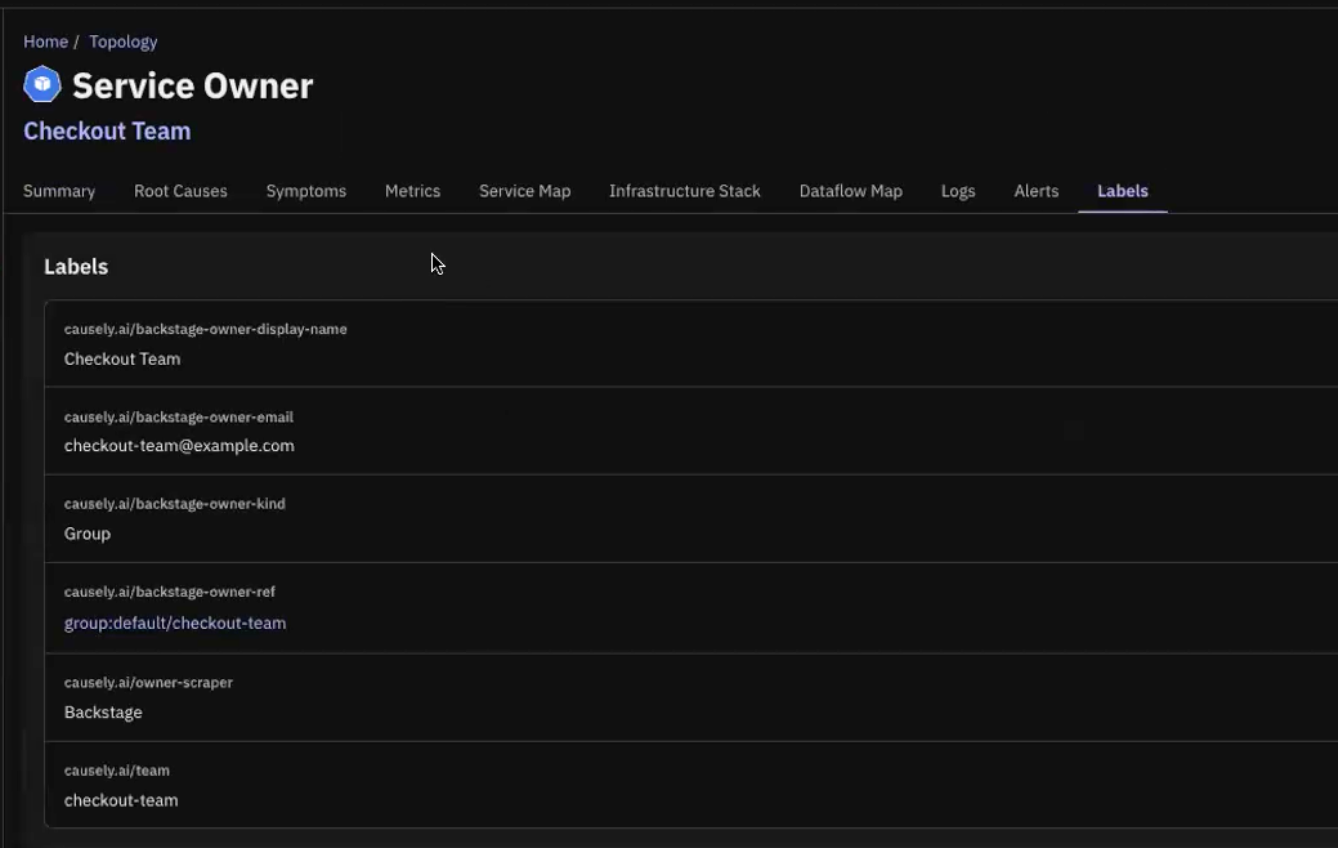
Enriched topology with ownership and metadata
Causely now integrates with Backstage, enriching the system topology with team ownership and component metadata (type, lifecycle, system). -
Faster triage with clear ownership context
For teams using Backstage as the system of record, Causely surfaces who owns the service or component involved in an issue—reducing time to identify the right team during incidents.
Expanded Alert Mapping to Entities
-
Broader alert coverage beyond modeled symptoms
Alerts can now be mapped to entities even when they do not correspond to an existing symptom in the causal model. -
Consistent deduplication across all alerts
The same deduplication logic is applied, reducing noise and improving signal quality. -
Improved visibility into model gaps
This makes it easier to identify high-frequency or critical alerts that should be incorporated into the causal model, helping continuously improve coverage and root cause accuracy.
Minor Improvements
- Improved Ask Causely behavior when determining relevant entities based on current scope
- Enhanced SLO views to better communicate remaining error budget
- Fixed an issue in the Slack app when identifying root cause from alerts
- Availability SLOs are now evaluated even when no traffic is observed