v1.0.116
February 19, 2026
Version v1.0.116Expanded Alert Mapping Support (HTTP Paths, Kafka Topics, JVMs)
Causely now supports alert mapping for:
- HTTP Paths
- Kafka Topics
- JVMs
This enhances Causely's ability to ingest and interpret alerts from systems such as Alertmanager, Mimir, Datadog, and others.
Mapped alerts are incorporated as symptoms in the causal model, allowing Causely to leverage the signals you already trust and use them as structured inputs into deterministic root cause analysis.
Improved Asynchronous Dataflow Understanding
We've enhanced the dataflow graph to provide a more complete view of asynchronous interactions.
Previously, the graph showed only queue publishers (e.g., RPC methods, service tasks, background operations). It now reflects the full lifecycle of a queue, including:
- Operations that consume from the queue
- Upstream and downstream services, RPC methods, or HTTP which are part of the flow
- End-to-end propagation across asynchronous boundaries
This provides a more accurate system-level view of cause and effect across distributed workflows, especially where queues introduce delayed or indirect impact.
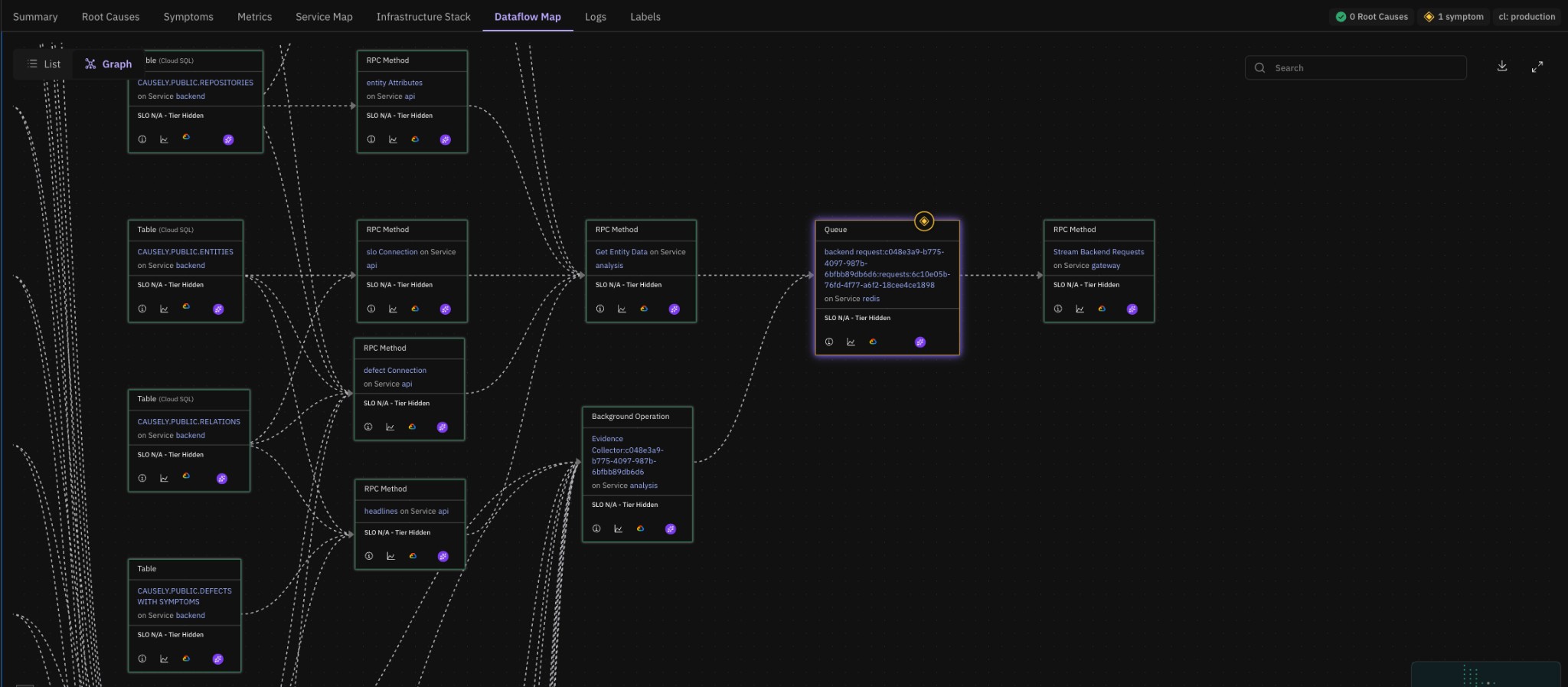
The Dataflow Map tab now shows the full queue lifecycle—publishers, the queue itself (e.g. on Redis), and consumers—so you can trace cause and effect across asynchronous boundaries.
SLOs for Queues (API)
You can now assign SLOs to specific queues that support critical product and user flows. This is currently configurable via the API. When a queue SLO is at risk or violated, any root causes affecting that queue or its upstream dependencies are automatically elevated as urgent. This ensures teams prioritize issues that directly impact key business workflows.
Example: If you need to ensure that an order-processing queue is drained within a defined time window, you can define an SLO using Queue Depth (or a related metric) as the SLI. Causely will then treat violations or burn risks as high priority and surface the most relevant causal explanations with an Urgent severity.
Minor Improvements
- OpenTelemetry integration health: Prevent Causely-generated entities from being re-reported via OpenTelemetry
- Copilot improvements: Improved answer quality when asking questions about Causely documentation in Ask Causely
- Snapshot selection: Improved visibility and selection of snapshots for Reliability Delta workflows
- Entity root cause history: Active and historical root causes are now shown directly on the entity view (for example a service or RPC method)