v1.0.125
Expanded MCP Coverage
The Causely MCP server adds five new tools and six new prompts, giving AI agents and automation workflows a broader set of operational capabilities without requiring custom context engineering.
New tools cover structured health summaries for any entity or full environment (get_entity_health, get_environment_health), integration status visibility (get_integration_status), label enumeration for filtering and search (get_label_values), and structured incident ticket generation (generate_ticket). Agents can now answer a wider range of operational questions, from environment-wide health snapshots to integration coverage gaps, using structured, causal-grounded outputs rather than raw telemetry.
New prompts cover error rate ranking across services, resource usage leadership, data asset consumer mapping, historical incident windows, external alert mapping to Causely's causal model, and database-focused investigation workflows. These give agents and users pre-built starting points for the most common observability and reliability queries.
Expanded Root Cause Coverage
Causely now detects and models additional root causes across Postgres, Redis, MongoDB, Kafka, and Kubernetes Node infrastructure, reducing the gap between where symptoms surface and where the actual cause lives.
Without these models, agents and on-call engineers must manually correlate infrastructure signals to application degradation. With them, Causely can identify the true origin of an incident, connection pool exhaustion, replication lag, storage pressure, and suppress downstream symptoms that would otherwise generate noise.
-
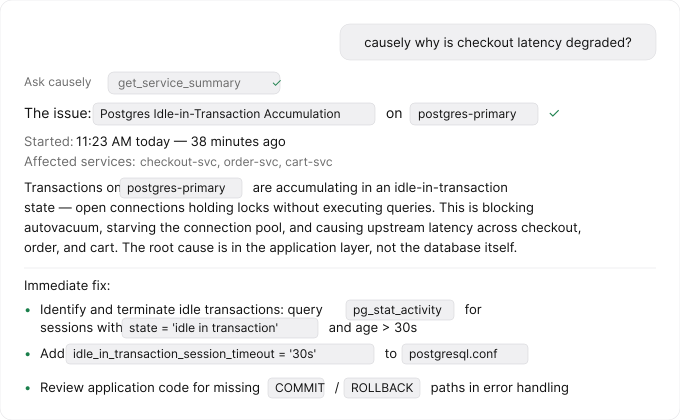
Postgres: Cache hit rate degradation, checkpoint I/O pressure, connection slot exhaustion, deadlock storms, idle-in-transaction accumulation, lock contention, replication lag, and query memory spill to disk.
-
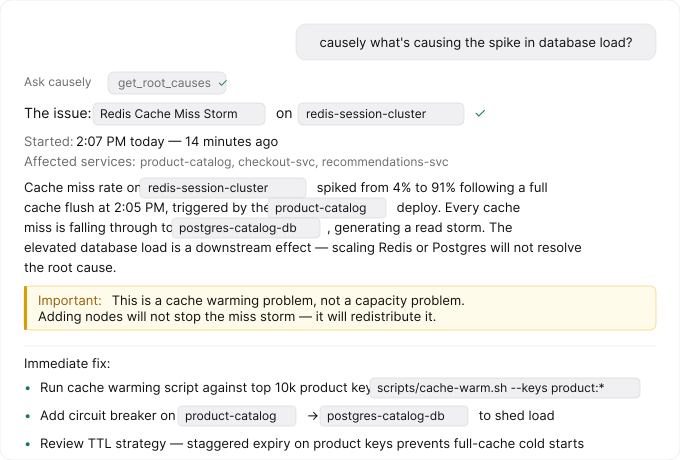
Redis: Cache miss storms, command queue saturation, memory pressure, and connection exhaustion.
-
MongoDB: Connection exhaustion, cursor pressure, and replica lag.
-
Kafka: Partition outages, replication degradation, and storage pressure.
-
Kubernetes Node: Causely Agent down detection, with root cause attribution across container runtime, filesystem, kernel, Kubelet, network, PID pressure, and malfunction conditions.
Example troubleshooting queries using Claude and Causely MCP
Log-Based Application Root Cause Detection
Causely now monitors application logs continuously and activates symptoms based on defined error patterns, extending causal analysis to common application-level failure modes.
Causely already captures and surfaces container logs alongside detected symptoms and root causes. These new root causes go further, continuously monitoring those logs for defined error patterns and feeding matching signals directly into Causely's causal analysis, so application-level failures are identified as named root causes rather than requiring manual log inspection to interpret.
This new capability adds 25 new application root causes spanning Java, Python, Go, and .NET runtimes, web and proxy layers (Nginx, HAProxy), and data systems (Cassandra, Elasticsearch, MySQL, RabbitMQ).
Minor Improvements
- MCP authentication: Static OAuth credential support added so long-running background agents no longer need to re-authenticate via bearer token. Learn more
- AWS ECS log retrieval: Agents and workflows can now retrieve logs from ECS containers.
- Operator update control: Automated update behavior is now configurable per cluster. Learn more
- Dynatrace management zones: Causely now discovers Dynatrace management zones and applies corresponding labels for search and filtering.
- Dynatrace alert polling: Increased monitoring frequency for faster detection of Dynatrace alert state changes.
- Notification payload: Expanded payload content for Causely alert notifications.
- Scope and topology filtering: Improved accuracy and coverage of scope and topology filters.
- Beyla 3.7.0: Updated to Beyla 3.7.0, improving trace fidelity for encrypted Java and Kafka communications.