Datadog Quickstart Guide
This quickstart guide will help you get Causely up and running with Datadog. This setup uses Datadog APM with dual shipping to send traces to Causely while continuing to send data to Datadog.
Get Your Installation Command
- Log in to the Causely portal.
- Visit the mediators page.
- Click the "Add new" button (or "Add ➕" button) on the mediators page.
- In the instructions panel, you'll see the Helm installation command with your access token pre-filled.
- Copy the complete Helm command. It will look similar to the example below.
The command you copy will include your specific access token and cluster name. Here's what it typically looks like:
export CAUSELY_TOKEN=<your_token>
export CAUSELY_CLUSTER_NAME=<your_cluster_name>
export CAUSELY_VERSION=<version>
helm upgrade --install causely \\
  --create-namespace oci://us-docker.pkg.dev/public-causely/public/causely \\
  --version "${CAUSELY_VERSION}" \\
  --namespace=causely \\
  --set image.tag="${CAUSELY_VERSION}" \\
  --set global.cluster_name="\${CAUSELY_CLUSTER_NAME}" \\
  --set mediator.gateway.token="\${CAUSELY_TOKEN}"
Screenshots of the mediators page, "Add new" button, and instructions panel will be added here.
Create a Values File to Disable eBPF
Since you'll be using Datadog for instrumentation, create a causely-values.yaml file to disable eBPF instrumentation:
global:
  cluster_name: <your_cluster_name>
mediator:
  gateway:
    token: <your_token>
scrapers:
  bpf:
    enabled: false
Replace <your_cluster_name> and <your_token> with your actual values from the portal.
Run the Installation Command
- Open a terminal with
kubectlconfigured to access your cluster. - Run the Helm command with your values file:
export CAUSELY_VERSION=<version>
helm upgrade --install causely \\
  --create-namespace oci://us-docker.pkg.dev/public-causely/public/causely \\
  --version "${CAUSELY_VERSION}" \\
  --namespace=causely \\
  --set image.tag="${CAUSELY_VERSION}" \\
  --set global.cluster_name="<your_cluster_name>" \\
  --set mediator.gateway.token="<your_token>" \\
  --values causely-values.yaml
- Wait for the installation to complete:
kubectl wait --for=condition=Ready pod -l app.kubernetes.io/part-of=causely -n causely --timeout=300s
Configure Datadog Dual Shipping
Now you need to configure your Datadog Agent to send traces to Causely using dual shipping.
Option 1: If using Helm to deploy Datadog
Add the following to your Datadog values.yaml:
agents:
  useConfigMap: true
  customAgentConfig:
    apm_config:
      additional_endpoints:
        'http://mediator.causely:8126':
          - 'datadog-receiver'
Then upgrade your Datadog installation:
helm upgrade --install datadog datadog/datadog -f ./values.yaml
Option 2: If using the Datadog Operator
Modify your DatadogAgent custom resource:
apiVersion: datadoghq.com/v2alpha1
kind: DatadogAgent
metadata:
  name: datadog
spec:
  override:
    nodeAgent:
      env:
        - name: DD_APM_ADDITIONAL_ENDPOINTS
          value: '{"http://mediator.causely:8126": ["datadog-receiver"]}'
For more details, see the Datadog integration documentation.
What to Expect
Once configured, Causely will:
- Receive Datadog traces: Your Datadog Agent will send traces to Causely's mediator via dual shipping.
- Discover service dependencies: Causely will automatically discover service dependencies from your Datadog APM traces.
- Show data in the UI: Within a few minutes, you should start seeing services and their relationships appearing in the Causely UI at https://portal.causely.app.
You can also enable Datadog monitors as a data source for additional insights. See the Datadog integration documentation for details.
Add More Telemetry Sources
To help Causely infer Diagnoses more effectively, connect additional telemetry sources. Visit the Telemetry Sources page to learn about the data sources that Causely supports, including:
- Prometheus
- OpenTelemetry
- Grafana
- Alertmanager
- And many more
Review Discovery
You have successfully installed Causely! Navigate to https://portal.causely.app to verify your environment has been discovered. You should see entities populated in the Topology view:
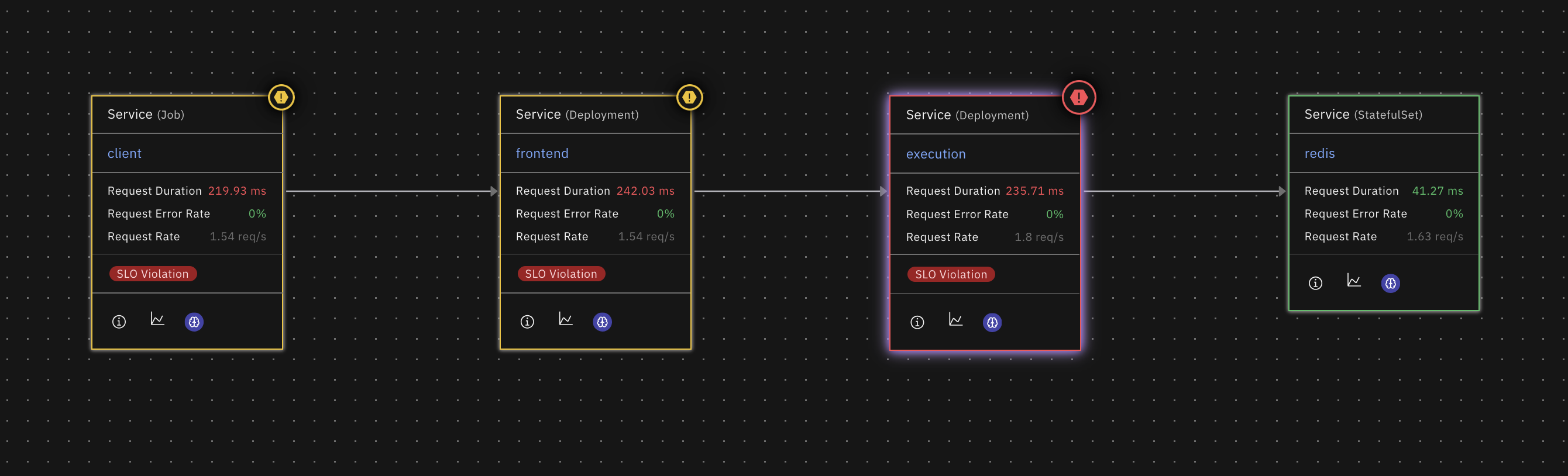
If the entities and connections you are expecting to see are not appearing, go to the Integrations page and check for any errors for the telemetry sources you have configured.

Errors in the integrations page will prevent Causely from discovering entities and connections in your environment. Follow the troubleshooting steps to resolve the errors.
Connect Causely to AI Agents
Give your agents access to Causely's causal model via the MCP server. Any MCP-compatible agent or assistant including Claude Code, Cursor, VS Code, HolmesGPT, or your own custom agent, can query root causes, service health, dependency maps, and reliability reports directly.
Visit the agent integration page to get started.
While this quickstart guide focuses on Kubernetes, Causely also supports:
- Container Orchestration: Nomad, Docker, ECS
- GitOps: Argo CD, Flux
- Virtual Machines: Direct installation on VMs
For detailed installation instructions for these platforms, visit the Installation Overview page.