v1.0.128
Alert-Driven Root Cause Urgency
Causely now sets root cause urgency based on the severity and volume of the alerts it explains. Previously, root cause severity was independent of alert severity, requiring engineers to manually cross-reference alert priority against active root causes to understand what demanded immediate attention. Root causes now inherit the highest severity from the alerts they explain: a root cause linked to a High or Critical alert is automatically marked urgent. Root causes that explain five or more alerts are also marked urgent regardless of individual alert severity, ensuring that broad-impact failures surface at the top of the queue.
MCP Skills and Tool Improvements
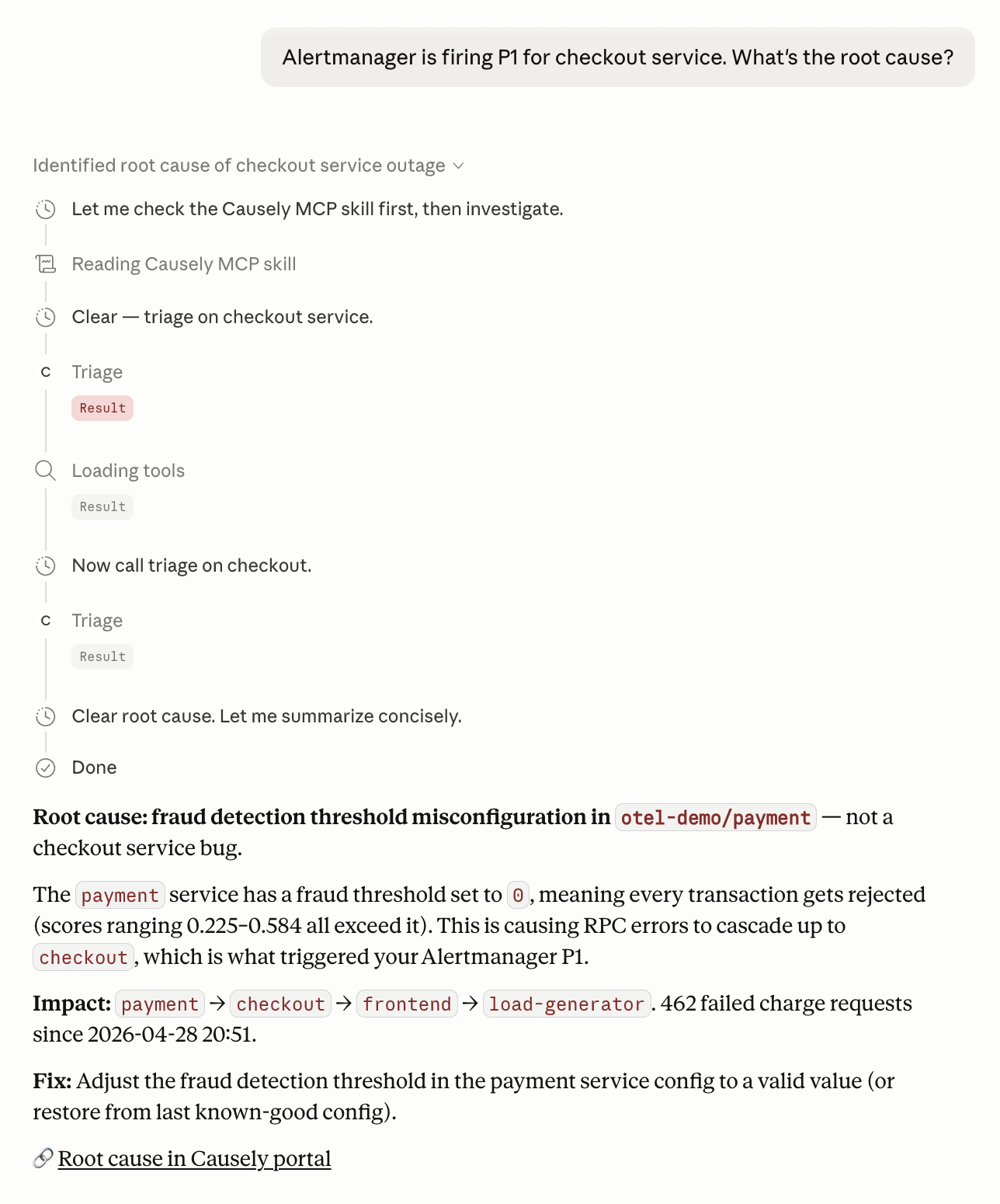
Causely now ships seven pre-built skills that package tools into structured investigation flows for use with Claude, Cursor, and other agents that support skills. Previously, agents had to chain raw tool calls manually, which required more tokens, more steps, and more prompt engineering to reach a reliable answer. The new skills cover common investigation patterns end to end, including alert investigation, entity health, and root cause retrieval, and are available out of the box with no additional configuration.
Several underlying tools have also been improved. Entity name lookup is now centralized, enabling agents to look up namespaces and clusters in addition to entities from a single tool, reducing the back-and-forth an agent previously needed to identify the right target. Alert investigation output is streamlined to surface cause context immediately. Entity health output is standardized across observation types, so agents receive consistent structure regardless of the signal source. Root cause retrieval has been expanded: queries about a pod now also surface active root causes on related controllers and containers, so agents are no longer limited to the exact entity named in the query. Causely also now provides richer detail on how a root cause was identified, enabling agents to clearly explain the causal reasoning behind each finding.
Minor Improvements
- Log evidence: Causely now collects and displays one hour of warning-level and above log events per entity. This gives engineers and agents a consistent evidence window for any entity showing symptoms, without requiring a separate log query.
- Trace handling: Improved mediator handling of large trace volumes, reducing processing pressure in high-throughput environments.
- AWS ElastiCache Redis: Optional IAM authentication is now supported, allowing teams that have IAM-based access controls on ElastiCache to connect without storing static credentials.
- Remediation language: Suggested remediations now clarify that recommendations are based on runtime observations. The updated language makes explicit that access to configuration, code, or runbooks would allow Causely to provide more precise guidance, setting more accurate expectations for automated and human-reviewed remediation workflows.