v1.0.135
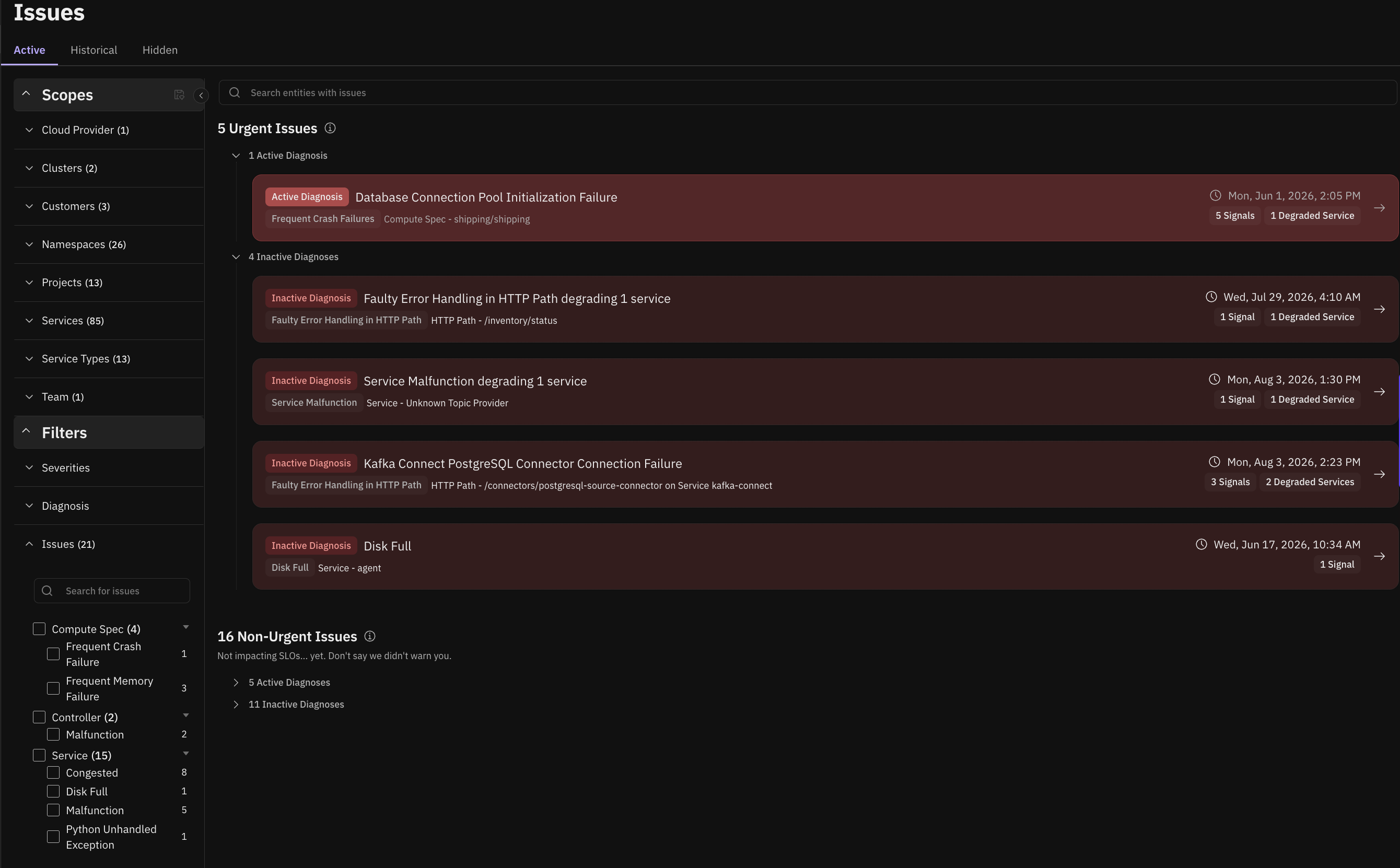
Introducing Issues
Causely now groups every diagnosis of the same underlying problem into a single Issue: one thing to acknowledge, one thing to share with your team, one thing to resolve. Before Issues, a recurring problem surfaced as a scatter of separate diagnoses with no durable object linking them, so on-call engineers rebuilt the through-line by hand each time it resurfaced. An Issue gives engineers and agents one place to see the problem, the evidence behind it, and the best path to resolution. This is an early access release, and we are working toward making Issues the primary notification payload Causely sends to agents and on-call channels.
As part of this release, Root Causes are now diagnoses and Symptoms are now Signals, giving on-call engineers and agents a more complete picture of an Issue, the evidence behind it, and the path forward.
Act on Issues
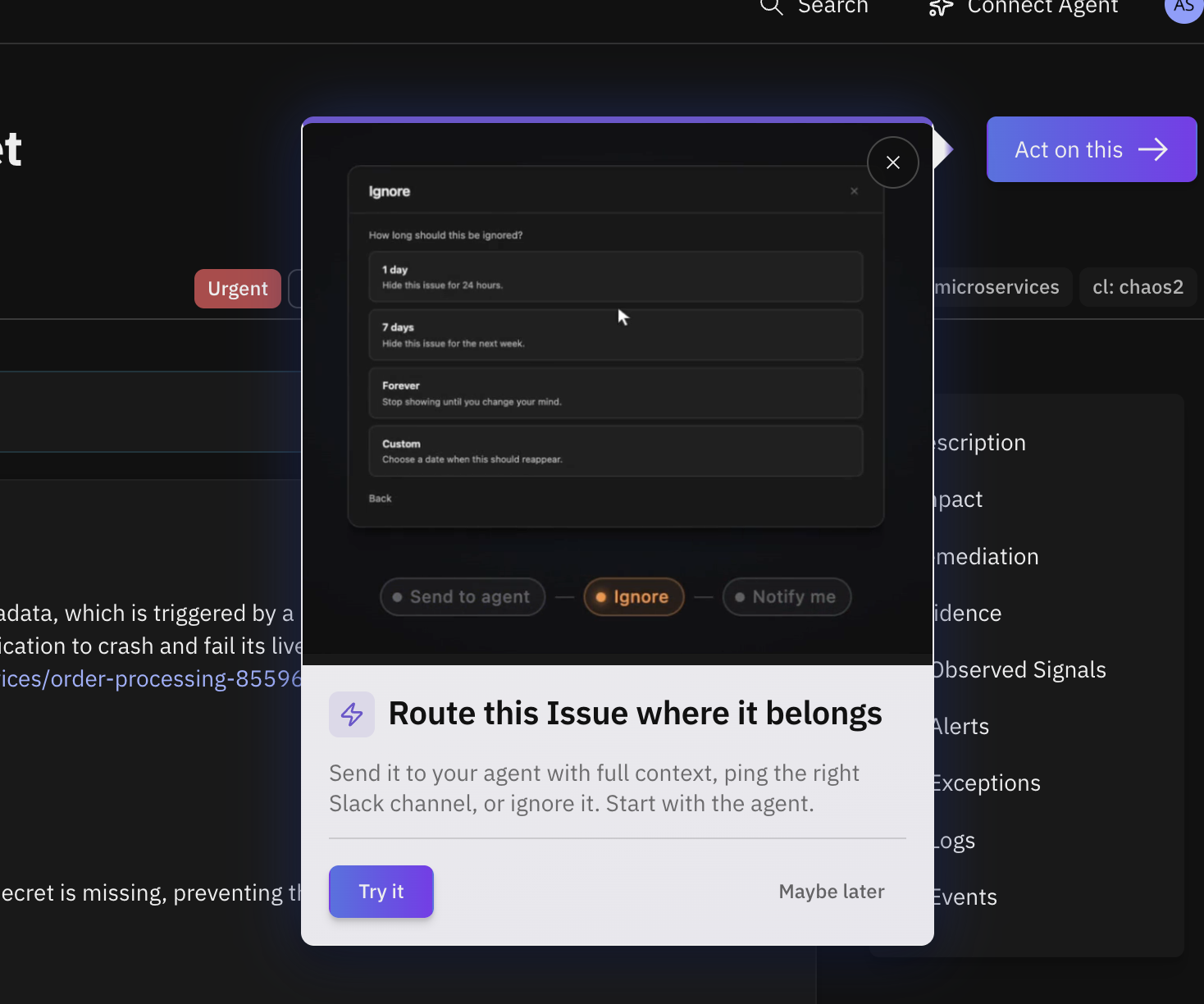
You can now act on an Issue directly from the UI, so triage no longer means leaving Causely to take the next step. Available actions:
- Send the Issue to an agent, for example Claude or Cursor, to investigate or resolve.
- Add a notification so the next occurrence is sent automatically to a Slack channel or a background agent.
- Snooze the Issue so a recurrence stops notifying you and moves to the Incidents tab.
MCP Tool Improvements
New Issues tools: get_issues returns active Issues across the environment, and get_issue_details returns a single Issue with every diagnosis grouped under it. These should be an agent's primary calls when determining what is currently impacting services or components.
count_entities is new. Agents can now grasp the shape of an environment, and what is currently breaking, in far fewer calls.
get_root_causes and get_root_cause_details have been replaced by get_diagnoses and get_diagnosis_details.
Note that skills have been updated to ensure efficient routing for these new tools. Make sure you update your agent to the latest skill definitions.
Minor Improvements
- Signal activation delay: You can now configure Signal activation delay directly from the UI. More here
- Notification payload: Custom names for diagnoses, formerly root causes, are now included in the notification payload.
- Google Cloud Mesh: Causely now discovers and stitches cross-cluster communication over Google Cloud Mesh. This delivers full topology mapping and causal attribution when services communicate across clusters, closing a blind spot that previously broke the dependency graph at the cluster boundary.More here
- Mediator trace processing: Improved mediator trace processing performance so fewer traces are dropped.