v1.0.138
Issues are now the primary notification
Notifications now reference the Issue rather than an individual diagnosis. Before this, a single problem could produce several notifications tied to different diagnoses, so engineers and agents picked up fragments of the same problem and worked them separately. Routing on the Issue means one problem produces one thread from detection to resolution, and the people and agents responding are looking at the same object.
A better Act on this
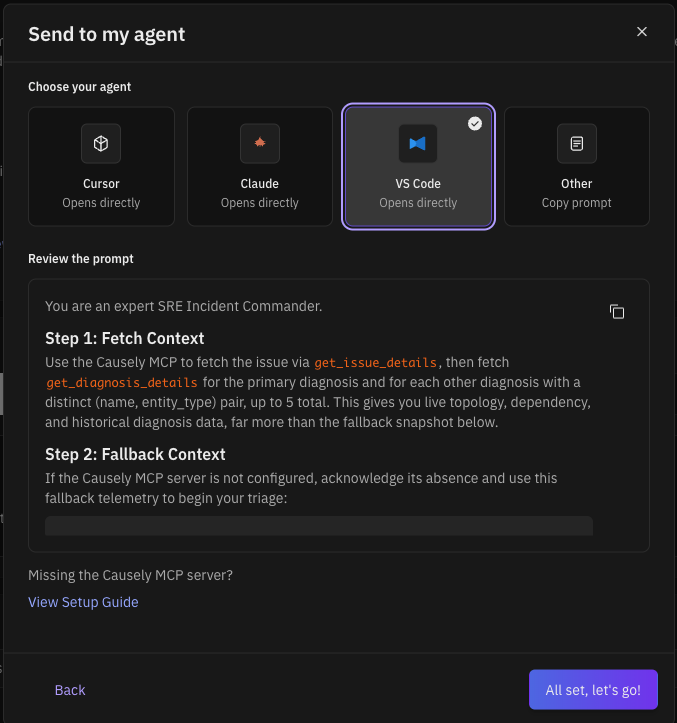
Act on this now carries more of the Issue with it. The generated prompt includes richer context, so it is useful even before you have connected an agent to the Causely MCP server. You can send an Issue straight to VS Code, and Act on this is now linked directly from Issue notifications, so responders go from the notification they received to an agent working the Issue without reassembling context on the way.
Optional auto-update for Mediator and agent
The operator can now update the Mediator and agent automatically. Before, staying current meant a manual upgrade step in each cluster, and environments drifted between versions. Turning auto-update on keeps clusters on the current version without an operator action per release. It is opt-in, so clusters that require change control can stay on manual upgrades.
Minor Improvements
- MCP Quick Start: Clearer setup path for connecting an agent to Causely.
- Gateway API topology: Causely now resolves backing services behind Kubernetes Gateway and HTTPRoute specs, including ServiceImports. Dependencies that previously terminated at the gateway now resolve to the service actually handling the route, which keeps blast radius and causality from being attributed to the gateway itself.
- Issue to diagnosis consistency: Improved consistency between an Issue and the diagnoses attached to it, and recurring occurrences of the same problem are now grouped on the Issue.
- External service impact notifications: When an external service degrades, owners of the client services impacted by it are now notified.
- Diagnosis summaries without evidence: A diagnosis now returns a summary even when supporting evidence is not available, so a diagnosis is never surfaced as an empty result.
- AWS ingress coverage: Broader discovery of AWS ingress configurations, including load balancers that route directly to pod IPs.
- GCP disk discovery: Disk limits are now discovered for g4 instance types and Hyperdisk.
- Prometheus fetch tuning: PromQL data fetching can now run in parallel with a configurable concurrency, which shortens collection time on large Prometheus sources.